
In short
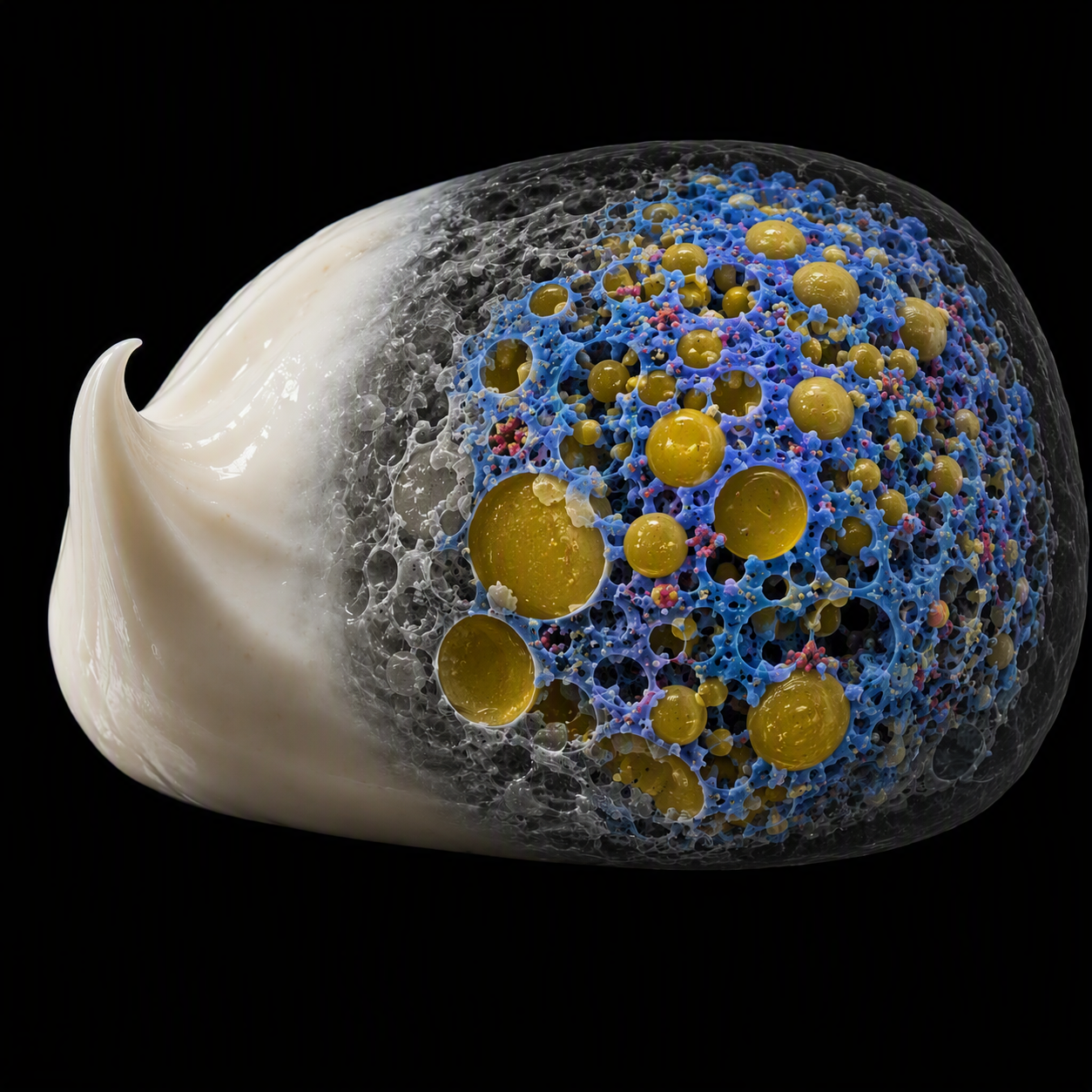
The microstructure of a cosmetic formulation – that is, the spatial organisation of its various constituents, from the supramolecular scale down to the scale visible to the naked eye – plays a key role in the ‘qualities’ of the product, in the broadest sense. Hence the need to understand and control it more effectively in order to ensure its commercial success. Here we describe a new 3D imaging technique whose performance is particularly well suited to visualising the microstructure of formulations.
Five reasons to take an interest in the microstructure of cosmetic formulations
– the microstructure determines the final texture,
– the microstructure can influence the product’s efficacy,
– it often plays a role in the product’s stability,
– the microstructure may also have implications for safety considerations,
– finally, and most importantly, consumer perception is sometimes closely linked to the microstructure.
It’s so difficult to achieve the right microstructure!
A cosmetic formulation is a mixture of ingredients with properties that are sometimes contradictory, such as emollients, surfactants, emulsifiers, preservatives, colourants, pigments and fragrances. Its microstructure depends not only on the nature and quantity of the ingredients, but also on the manufacturing processes, i.e. the way to assemble them. However, the balance achieved can be fragile and susceptible to changes caused by temperature, humidity, the application process itself or during storage. The art of formulation lies in developing an effective and robust formulation that meets the marketing team’s requirements.
The need for advanced characterization tools
Until recently, formulators relied mainly on optical microscopy to visualise the microstructure of their formulations; however, this technique only provides 2D images of the products spread between a slide and a cover slip. Confocal microscopy is now also used, as it allows samples to be examined to a depth of several hundred µm. It is now possible to overcome these limitations using X-ray computed tomography (XCT). This three-dimensional X-ray technique enables the interior of objects to be visualised, digitised and analysed without any prior preparation, for volumes of up to several cm³. The use of a synchrotron X-ray beam significantly improves the performance of XCT in terms of spatial resolution (less than 1 μm) and sensitivity. The quality of the images makes it possible to observe the internal structure of the product and to clearly distinguish, for instance, between lipid and aqueous phases. It is also possible to analyse the size, shape, arrangement and distribution of the ingredients and the various phases. The icing on the cake is that it is even possible to monitor, in real time on a timescale of a few minutes, the changes that occur under the influence of various stresses (shear, temperature, humidity, etc.)
Four reasons to benefit from Novitom’s expertise in XCT for cosmetic products
– to visualise and analyse the distribution of phases and ingredients in a finished formulation (water, oil, pigments, etc.),
– to view and track cosmetic films applied to the skin, hair or nails,
– to better highlight the effect of the products and, when possible, corroborate consumers’ perceptions,
– to check and analyse the stability of the products.
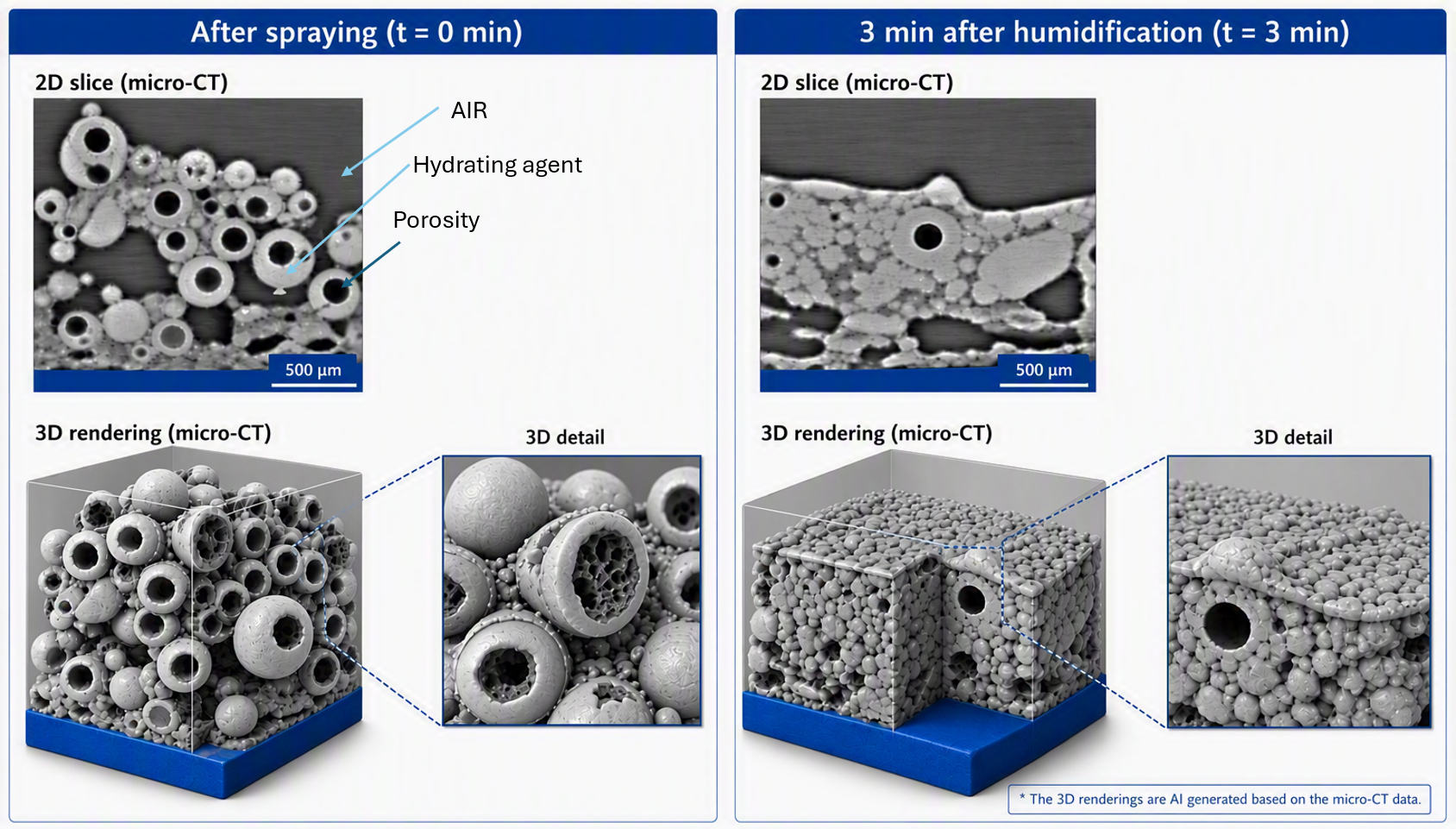
Inside the Spray: What Really Happens to Your Antiperspirant at 10,000x Zoom
A 3D close-up at 10,000x magnification of a single spray of antiperspirant reveals that what appears to be a fine, uniform mist actually settles on the skin as an irregular, porous dispersion of droplets, full of voids and trapped air pockets.
Traditional tests never catch this. A rub test tells you how it feels to the touch. A 24-hour wear test tells you whether people stayed dry. Neither of these tells you what is physically happening on the surface during the first five minutes: whether the product actually forms a continuous, functional barrier, or whether it simply remains there in the form of scattered droplets, ready to be wiped away by rubbing.
It is this invisible structure that really determines whether a formula is effective — or whether it merely gives the impression of being so. This invisible structure is what actually decides whether a formula performs — or just feels like it should.
Business contact:
Danilo Rosa Nunes
danilo.nunes@novitom.com