
Microbiome-related claims have proliferated over the past decade, in response to consumer expectations, in step with advances in skin sampling methods, and in line with the latest innovations in multi-omics analysis. The following outlines what constitutes a credible, scientifically robust clinical evaluation capable of meeting these challenges.
Why the clinical dimension matters
The skin hosts an estimated one trillion microorganisms and more than 1,000 bacterial species, together with fungi, viruses and mites. Their distribution is not uniform. Sebaceous areas such as the forehead favor lipophilic bacteria such as Cutibacterium acnes. Moist areas such as the axillae are dominated by Corynebacterium and Staphylococcus epidermidis. Dry areas such as the forearms harbor a broader diversity of taxa. Each individual also carries a distinctive microbial signature, shaped by genetics, hormonal status, age, lifestyle and environment.
This bacterial community is far more than a transient presence on the skin. It forms a biofilm at the epidermal surface, contributes to barrier function, helps regulate inflammation and protects against opportunistic pathogens. When this balance is disrupted, dysbiosis is associated with conditions such as acne, atopic dermatitis and dandruff.
Acne offers a telling example, as it cannot be reduced to an excess of C. acnes. This bacterium is in fact a normal resident of healthy sebaceous skin. Current research highlights differences between strains and phylotypes, as well as their interactions with sebum, host immunity and other species such as S. epidermidis.
For the evaluation of dermocosmetic actives and finished products, this translates into three major benefit categories:
- rebalancing effects (prebiotic, probiotic, postbiotic);
- probiotic-like effects;
- antimicrobial effects.
Consumers have followed suit. Between 2018 and 2023, launches bearing a microbiota-related claim grew by 68% per year, according to Innova Market Insights. The pressure to substantiate these claims has grown just as rapidly.
Microbiota or microbiome: what are we measuring?
The skin microbiota refers to the collection of resident microorganisms. The microbiome is a broader concept: a functional ecosystem encompassing genomic data, structural biomolecules and metabolic activity. A study that enumerates bacteria supports a claim about the microbiota. A study that demonstrates what those bacteria do supports a claim about the microbiome. The wording of a claim should therefore reflect the level of evidence on which it rests.
Three approaches, three questions
Cosmetic activity on the microbiota can be assessed in vitro, ex vivo and in vivo. Each approach addresses a distinct question.
In vitro assays, fast and cost-effective, provide a reproducible snapshot for raw material screening, but disregard interspecies interactions. Co-culture systems (2024 TUS medium, four bacteria) and 3D reconstructed skin models narrow this gap, without the variability inherent to human volunteers.
Ex vivo studies, conducted on human skin explants or on swabs collected from volunteers, offer a more realistic surface. They are particularly valuable where ethical constraints limit in vivo testing. None of these approaches, however, observes bacteria within their natural context. This is the role of in vivo studies, which evaluate the microbiota together with the host, over time and under real conditions of use. The trade-off is well established: a broader perspective, at the cost of greater inter-individual variability, longer timelines and higher costs.
Designing a robust in vivo/ex vivo study
Inter- and intra-individual variability represents the central challenge. Age, sex, anatomical site, diet, hygiene practices and season all influence the baseline. Only a rigorous methodology can address this. It requires:
- careful subject selection;
- a clearly defined sampling site;
- a controlled comparison between treated and placebo (or untreated) areas;
- sampling before and after application over several weeks.
Bioinformatics and statistical modeling then make it possible to distinguish a treatment effect from natural fluctuation. Without them, neither causality nor the long-term impact of a product on microbial homeostasis can be demonstrated.
Sampling itself must be standardized to ensure data integrity. In cosmetic studies, swabbing and tape stripping are the standard methods.
- Swabbing is simple, non-invasive, rapid and inexpensive. It is compatible with 16S, ITS and shotgun analyses. However, it reaches only the surface, sometimes yields limited DNA and carries a risk of contamination.
- Tape stripping samples slightly deeper. It is standardized and inexpensive, but minimally invasive, and yields more fragmented DNA.
- Biopsies provide access to deeper layers and to host tissue. They are, however, invasive and painful, raise ethical constraints, limit volunteer recruitment and are more costly. They are rarely appropriate for cosmetic studies.
At-home self-sampling kits, which are becoming increasingly widespread (HelloBiome, Sequential, Byome Labs), make large-scale studies feasible. Inter-user variability, handling errors and uncontrolled storage conditions must nevertheless be taken into account. Protocols compare swab samples from the treated area and from the untreated or placebo area, before and after treatment.
Ethics warrants particular attention. Informed consent, anonymization of genetic data and the safety of any microbial exposure are essential. Ethics committees frequently require detailed protocols, especially for vulnerable populations such as infants or individuals with pre-existing skin conditions.
From enumeration to sequencing
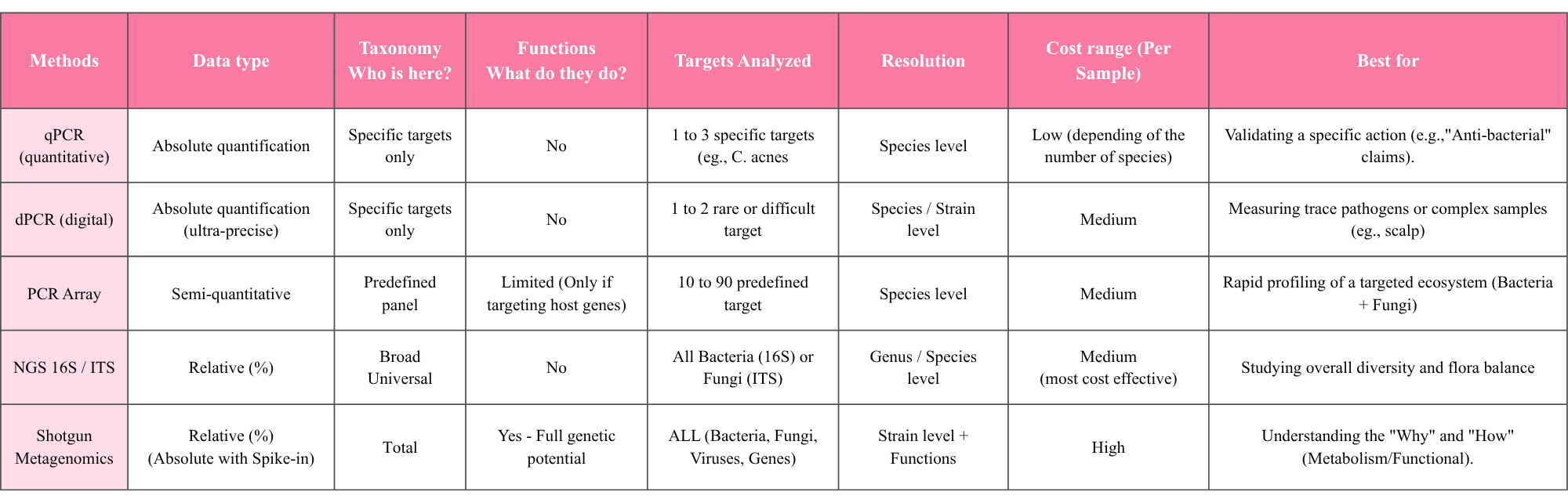
Sample processing begins with simple quantitative techniques such as colony-forming unit (CFU) enumeration. Molecular methods follow: first qPCR for known targets, then sequencing.
Amplicon sequencing is the most widely used approach to characterize community composition. It involves determining the sequence of a specific DNA fragment previously amplified by PCR. This amplified fragment is referred to as an “amplicon”.
In microbiome studies, the target is a gene present in all organisms of a given group but variable between species, such as the 16S rRNA gene for bacteria or the ITS region for fungi. This single gene is amplified from the sample, sequenced, and the resulting sequences are compared against reference databases. This identifies which microorganisms are present and in what proportions. It is a valuable screening tool, with little interference from host DNA. It nevertheless provides taxonomic information only (which organisms are present) and remains subject to primer bias, variable DNA extraction efficiency and lower taxonomic resolution.
While PCR allows rapid identification of known sequences, next-generation sequencing (NGS) offers a broader perspective: as a hypothesis-free approach, it enables the detection of novel genes with greater sensitivity. Shotgun metagenomics builds on this capability by sequencing all the genes of all the microorganisms in a sample. It makes it possible to assess microbial diversity and measure species abundance under different conditions, and provides functional information: which organisms are present and what they are capable of doing. It detects taxa down to approximately 0.01% relative abundance and makes it possible to address mechanistic questions relating to metabolism, virulence and resistance. In return, it requires more demanding bioinformatics, and skin samples contain a high proportion of host DNA.
The two techniques are frequently combined: 16S or ITS for screening, shotgun for in-depth analysis. The cost of 16S sequencing fell more than tenfold between 2015 and 2024, which now makes larger clinical datasets achievable.
Sequencing is not the only option; imaging provides a useful complement. As porphyrins produced by C. acnes are fluorescent, they can be visualized at the skin surface, for example through digital image analysis. Confocal microscopy, in turn, enables non-invasive, real-time observation. These techniques do not deliver a complete taxonomic profile, but they offer a valuable visual readout.
Beyond diversity: multi-omics and data integration
An “omics” approach aims to analyze, comprehensively, an entire class of molecules within a sample: all genes (genomics), all RNA transcripts (transcriptomics), all proteins (proteomics) and all metabolites (metabolomics).
The integration of these different layers, known as multi-omics, links composition to function. High-resolution mass spectrometry is the core technique of proteomics, metabolomics and lipidomics, just as sequencing is the core technique of genomics and transcriptomics.
The multi-omics approach makes it possible to understand how a product acts on both the host and its microbiome.
This is where bioinformatics becomes decisive. Analytical pipelines quantify relative abundance, diversity indices and functional gene expression. They draw on metadata to test associations with sequencing results.
The distinction between an observation and a proof is illuminating. “The product alters the quantity of bacteria” is an observation. “The product increases the relative abundance of S. epidermidis, and metagenomic data show a concomitant increase in the expression of anti-inflammatory genes” begins to constitute a mechanistic argument. This is the type of evidence that supports claims such as “maintains microbial balance”. Several providers now offer integrated platforms combining metagenomics, metaproteomics and metabolomics for this purpose.
Labels and regulatory uncertainty
To date, there is no specific global regulation governing skincare products or ingredients targeting the skin microbiome. Brands must comply with the rules applicable to all cosmetics with respect to safety, composition and claims. In 2021, the ICCR published a report entitled “Microbiome and Cosmetics” to define key terms. Interpretation and enforcement nevertheless still vary across regions.
In the meantime, several laboratories have developed their own labels, such as “microbiome-friendly”, “respect the microbiome”, “kind to biome” or “maintains the microbiome”. Most rely on in vitro or ex vivo protocols. At least one certification is based exclusively on in vivo volunteer studies. These labels generally assess whether a product preserves microbial diversity and key species while remaining well tolerated. They are useful communication tools that reassure consumers. They are not, however, regulatory certifications, and brands should present them accordingly.
Selecting the appropriate method has become as much a sourcing question as a scientific one. On Skinobs, brands and formulators can currently compare 15 clinical solutions offered by 81 providers, as well as 67 preclinical solutions from 58 providers. They can thus identify the protocol best suited to the claim they wish to make. The most useful question to ask any laboratory is a simple one: what exactly will this study allow me to claim?
Outlook
Since 2012, the microbiome has generated considerable enthusiasm among smaller brands and within dermocosmetics, whereas major brands and the premium segment have remained cautious. This reticence reflects the relative immaturity of the discipline, particularly in skincare: sampling is complex, longitudinal follow-up is challenging, and the microbiome is shaped as much by lifestyle as by genetics. Many claims therefore put forward effects that remain uncertain. Given the high variability of the skin microbiota, there is no universal “ideal” composition to aim for. Evidence will stem from function, and from the integration of sequencing, high-resolution mass spectrometry and dedicated analytical pipelines.
In 2026, the beauty industry is undergoing a profound transformation in an increasingly connected, digital and personalized world, in which social media shapes beauty routines. To meet the expectations of these new consumers seeking products that act on the microbiome, cosmetic brands are developing personalization based on targeted microbiota analyses, which are essential for delivering microbiota-centered product recommendations. With the rise of digital technologies, the miniaturization of measurement devices, artificial intelligence and data analytics, this personalization of microbiota-targeted cosmetic care is becoming increasingly sophisticated, driven by advances in swab-based sampling and analytical techniques.
References
- Skinobs (2026). Understanding Skin Microbiome Evaluation: From Science to Claims Substantiation. White paper.
- Charpentier A. (2026). Assessing the Skin Microbiome Claim: From in vitro Assays to Comprehensive Understanding. Industries Cosmétiques, issue 49, pp. 38-39.
- Skinobs webinar (15 January 2026). Understanding Skin Microbiome Evaluation from Science to Claims Substantiation.
- ICCR (2021). Microbiome and Cosmetics.
- Tokyo University of Science (2024). TUS Skin Bacteria Co-culture (TSBC) medium.
- Innova Market Insights, as cited in the Skinobs white paper.