

Evaluating the efficacy and safety of cosmetic ingredients requires reliable technologies that measure cell viability and cellular activity. Lumit® hKi-67, a bioluminescent technology based on enzymatic complementation, offers a robust and sensitive solution for quantifying cell proliferation.
The Principle
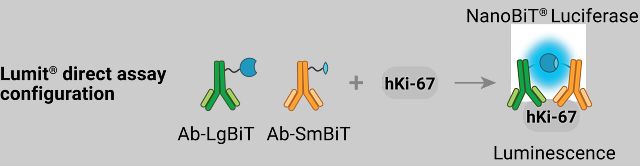
The assay uses two antibodies directed against hKi-67 protein, expressed exclusively in actively dividing cells. Each antibody is labeled with a NanoBiT Luciferase fragment : LgBiT and SmBiT. When hKi-67 is present in the cell, these two fragments come into proximity and reassemble into a functional luciferase. Addition of the NanoLuciferase substrate then generates a luminescent signal proportional to hKi-67 levels and thus to cell proliferation.
Practical Advantages
Bioluminescent technology offers superior sensitivity compared to colorimetric methods as MTT, reducing background noise and improving detection sensitivity.
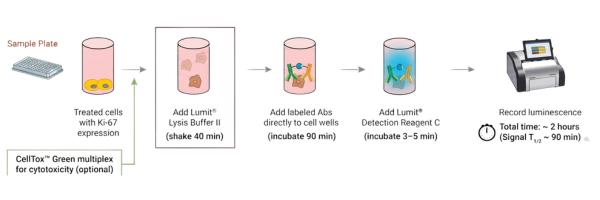
The assay requires no wash steps, reducing handling time and assay variability. It enables detection of proliferation changes as early as 24–48 hours and operates in both 96- and 384-well formats.
This technology distinguishes active proliferation from simple cell viability. Indeed, there are two distinct parameters particularly relevant for assessing cosmetic ingredient efficacy and tolerability.
Multiplexing capability is further enhanced by compatibility with CellTox™ Green, enabling simultaneous measurement of proliferation and cytotoxicity in the same well — a powerful approach for comprehensive toxicology and efficacy screening in cosmetic and pharmaceutical applications.
Applicability
Lumit® hKi-67 has demonstrated robust performance in both 2D cell cultures and 3D spheroids and organoids, and now extends to reconstructed human epidermis (RHE), offering flexibility for increasingly complex biological models used in cutaneous biology. Its integration into high-throughput workflows facilitates systematic screening of cosmetic ingredients.
Contact :
Isabelle Prost