
What if the effects of a cosmetic product could be both measured precisely and seen directly?
At Loretta, High-Speed Atomic Force Microscopy (AFM) is used to analyse the surface of skin cells and hair fibres at the nanometric scale. The approach combines striking high-resolution images with quantitative measurements, providing cosmetic companies with a new way to evaluate product efficacy, investigate mechanisms of action and communicate results.
From changes appearing only 15 minutes after application to effects developing over several months, Loretta’s technology is designed to follow the evolution of skin and hair with high precision — while remaining fast enough for cosmetic R&D and efficacy studies.
From an image to quantitative evidence
Atomic Force Microscopy is a surface-imaging technique based on an extremely fine probe that scans across a sample. As the probe follows the surface, it records variations in height and reconstructs its three-dimensional topography with nanometric precision.
This creates detailed images capable of revealing structural changes that cannot be observed with conventional photography or optical microscopy.
But AFM is not simply an imaging technology. Each image contains topographical data from which objective and quantitative parameters can be extracted. Loretta combines this information with statistical analysis to compare samples, groups and time points. The result is a particularly useful combination for cosmetic companies: visual before-and-after evidence for communication, supported by numerical data for scientific substantiation.
Skin analysis: monitoring changes from minutes to months
For skin studies, Loretta analyses the surface of corneocytes, the cells located in the outermost layer of the epidermis.
These cells can be collected quickly and non-invasively using tape-stripping, making the method particularly convenient for cosmetic studies. Once collected, samples can also be stored for several months at room temperature without degradation, facilitating studies with multiple time points, large panels or samples collected at different locations.
High-Speed AFM can detect changes occurring over very different timescales. Measurements can be performed as early as 15 minutes after product application, but also after weeks or several months of use, allowing both immediate and longer-term effects to be investigated.
The technology is effective on skin samples from different ages and skin tones, without relying on optical color-based measurements.
By analyzing the nanometric topography of corneocytes, Loretta can investigate biomarkers providing information related to key aspects of skin condition, including hydration, barrier function, elasticity and age-related changes, as well as cellular condition and health. These biomarkers are supported by published scientific research demonstrating their relevance.
For cosmetic brands and ingredient suppliers, this provides an opportunity not only to determine whether a product produces a measurable effect, but also to better understand how the skin evolves in response to treatment.
Hair analysis: making cuticle condition visible and measurable
The same technology can be applied directly to the surface of hair fibers.
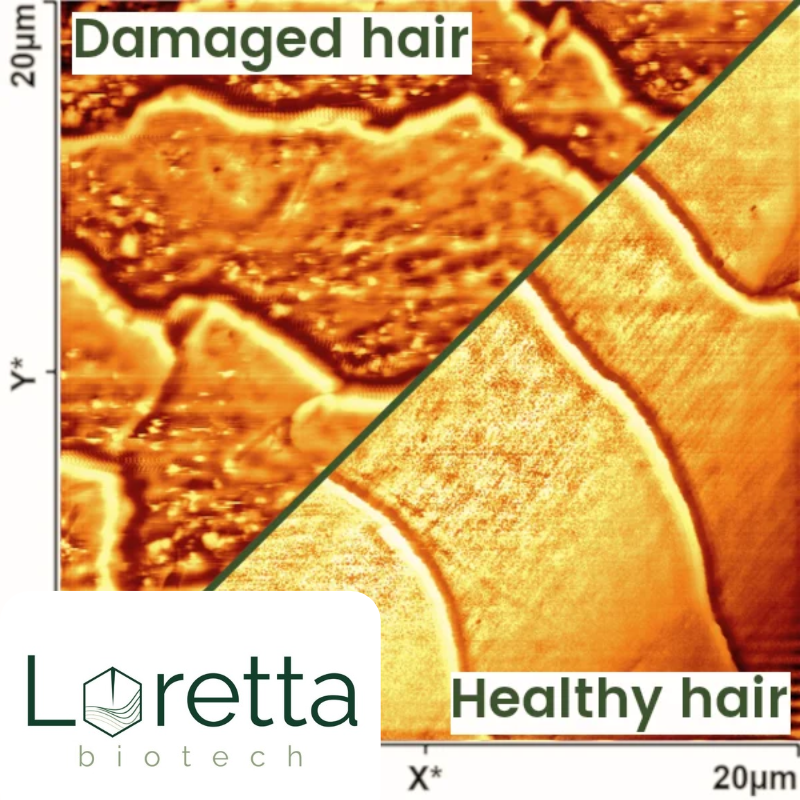
High-Speed AFM produces detailed images of the hair cuticle, making differences between healthy and damaged fibers immediately visible. These images can be particularly powerful for product launches, trade shows, scientific presentations and marketing communication, because they provide a direct visual representation of hair surface condition.
Behind each image, however, is a complete quantitative dataset.
Loretta can measure parameters such as cuticle surface roughness, cuticle-edge regularity, cuticle lifting and vertical micro-striations, alongside other morphological features. These parameters provide information related to hair condition, including surface damage, smoothness, shine and permeability.
Before-and-after studies can therefore measure how a shampoo, conditioner, mask, ingredient or treatment modifies the hair fiber, helping R&D teams compare formulations and helping claims teams support product performance with objective evidence.
With a capacityof up to 100 hair samples per week, Loretta’s High-Speed AFM brings nanometric imaging to a throughput compatible with industrial development. It offers a level of detail comparable to electron microscopy while providing direct three-dimensional surface measurements and significantly faster analysis.
Precision, speed and scientific support
For cosmetic companies, the strength of the approach lies in bringing several benefits together: nanometric precision, quantitative results, compelling before-and-after images and high analytical speed.
Studies are supported from beginning to end by Loretta’s scientific team, from study design and sample analysis to data interpretation, statistical comparisons and final reporting.
Based on patented High-Speed AFM technology and supported by multiple published scientific studies, Loretta’s approach turns the microscopic surface of skin and hair into actionable information.
For R&D, it means understanding product effects in greater detail. For claims teams, it provides objective and quantitative evidence. And for marketing teams, it creates something increasingly valuable: scientific results that can also be seen.