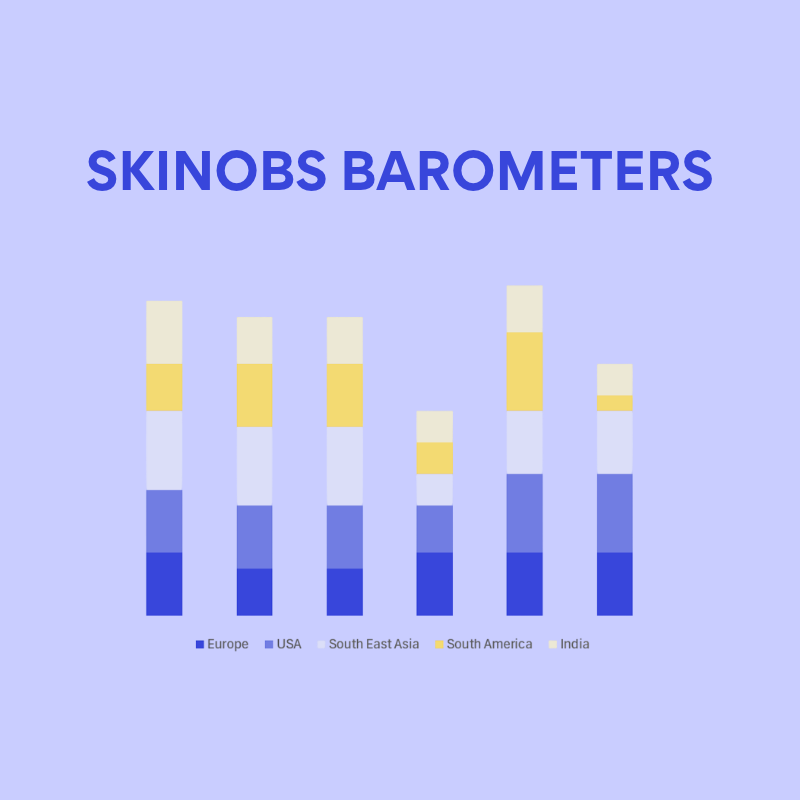
The Skinobs Barometers are based on expert scoring that draws together information gathered through exchanges with stakeholders in the testing sector worldwide (consultants, evaluation managers at cosmetic and ingredient companies, technical managers of testing laboratories and academic researchers), through participation in scientific congresses and industry trade shows, and through the review of scientific and marketing publications in the field of evaluation.
On this basis, Anne Charpentier, founder and CEO of Skinobs, rates from 1 to 5 the importance of key cosmetic claims, testing practices and market drivers across Europe, the United States, South East Asia, South America and India. Informed by her daily work with brands, laboratories and service providers, these scores highlight trends and contrasts between the territories and help brands identify weak signals and noteworthy developments within the sector.
These barometers confirm that there is no universal truth in cosmetic claims. While moisturising unites all markets, each territory then expresses its own priorities, standards of evidence and constraints. For brands, the challenge is no longer simply to provide proof, but to provide the right proof, using the method best suited to the target market, and also to communicate clearly with consumers through relevant arguments capable of earning their trust. Reading the market with discernment, selecting tests with rigour and formulating claims with precision: such is the condition for credible innovation, everywhere in the world.
Moisturising is the only claim that every territory ranks first. Beyond it, priorities, testing practices and market pressures diverge. The October 2026 barometer compares Europe, the United States, South East Asia, South America and India.
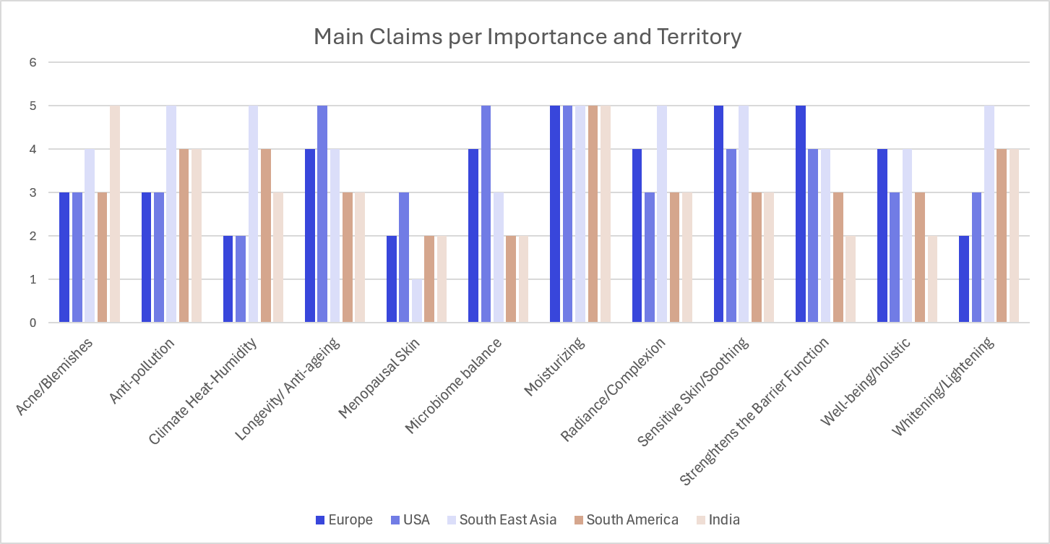
Let us begin with the common ground. Moisturising achieves the maximum score, 5 out of 5, in all five territories. It is the foundational claim of skincare, and any brand operating internationally must be able to substantiate it before any other. Beyond this shared foundation, the barometer reveals five distinct profiles.
Five Territories, Five Priorities
Europe regards the skin as an ecosystem to be preserved. Strengthening of the barrier function, together with sensitive skin and soothing claims, both reach a score of 5. Microbiome balance, longevity, radiance and wellbeing follow at 4. Whitening and climate-related claims score only 2. The United States takes a longer-term view. Longevity and anti-ageing, as well as microbiome balance, reach 5, while barrier function and sensitive skin stand at 4. It is also the territory where menopausal skin scores highest (3), although this claim remains a niche everywhere; it scores lowest in South East Asia (1).
South East Asia presents the most pronounced profile of the five. Six claims reach the maximum score: moisturising, anti-pollution, climate (heat and humidity), radiance and even complexion, sensitive skin and soothing, and whitening and lightening. Heat, humidity and urban pollution shape consumer expectations of products, as confirmed by our observations on the Skinobs platform: users targeting Thai laboratories search primarily for anti-pollution and sun protection claims. Microbiome balance scores 3 in the region, a sign of growing interest that has yet to become dominant.
India stands apart, with acne and blemishes at 5, the highest score for this claim across all territories, on a par with moisturising. Anti-pollution, as well as whitening and lightening, follow at 4, while barrier function, microbiome balance and wellbeing all score 2. Indian demand is driven by visible, tangible concerns rather than by the notion of a skin ecosystem, which makes acne a natural gateway to the microbiome in this market.
South America shares part of this profile, with anti-pollution, climate, and whitening and lightening at 4 alongside moisturising, and microbiome balance at 2.
How Each Market Substantiates its Claims
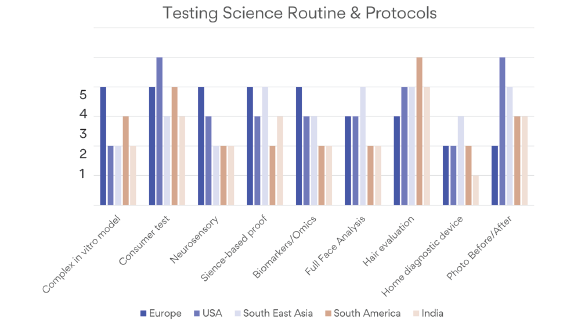
The October 2026 barometer on testing practices shows that territories also differ in the way they demonstrate what products and ingredients claim.
Europe favours science and sensory evaluation: complex *in vitro* models, neurosensory tests, science-based evidence, as well as biomarkers and omics approaches, all score 4, as do consumer tests, whereas before and after photographs score only 2. The United States reverses this pattern, with consumer tests and before and after photographs at 5, and complex *in vitro* models at 2.
South East Asia combines both approaches, with full-face analysis, science-based evidence, before and after photographs and hair evaluation all at 4. It is also the territory that gives the highest score to home diagnostic devices (3), a method that remains marginal elsewhere and reaches only 1 in India. South America gives hair evaluation the highest score of the entire barometer (5), with consumer tests at 4. In India, the highest-rated practice is likewise hair evaluation (4), while most other methods remain at 3 or below.
What Shapes the Testing Market
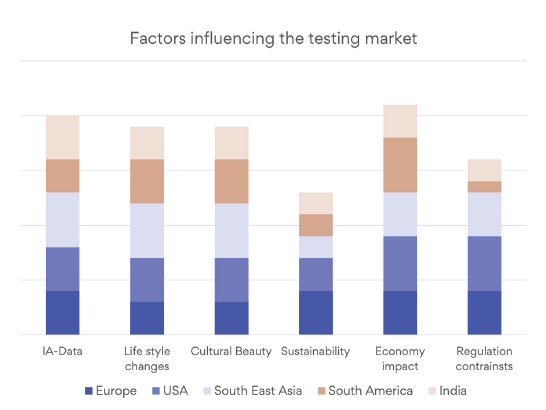
The barometer also examines the factors influencing the testing market, and the answer varies by territory. Economic impact carries the greatest weight overall, driven by South America and the United States, which both score it 5. AI and data come next, with South East Asia at 5 and Europe, the United States and India at 4. Lifestyle changes and cultural beauty codes follow with equal weight; in both cases, South East Asia scores 5, a sign of a market in which local beauty codes strongly guide testing choices. The weight of regulatory constraints varies considerably depending on the target market. They score 5 in the United States, 4 in Europe and South East Asia, but only 2 in India and 1 in South America. Sustainability is the least decisive factor overall: Europe is the only territory to give it a 4, compared with 3 in the United States and 2 in the three other territories.
One Claim, Many Markets
A single claims dossier cannot suit every market. A microbiome-targeted product launched in Europe and the United States will find an audience receptive both to the product and to the scientific evidence that supports it. In South East Asia and India, the same product will most likely need to be linked to tangible benefits, such as acne, pollution or humidity, and supported by facial analysis or visual evidence. The question remains the same: which claim, in which territory, and which test to substantiate it?
This is precisely what Skinobs helps to answer, by connecting the evaluation managers of cosmetic brands, from indie labels to the largest groups, and of ingredient manufacturers with testing laboratories around the world.
The Skinobs Barometers are a unique strategic intelligence tool, synthesising the major global trends in the cosmetic testing market.