1. The Skin and Scalp Microbiome: A Functional Ecosystem
The skin is home to a complex microbial ecosystem composed mainly of commensal microorganisms that coexist with the host. Far from being passive, these communities occupy specific niches and contribute to protecting the skin against external threats. They also interact closely with the immune system and play a central role in maintaining skin balance and overall homeostasis (Grice & Segre, 2011).
The scalp hosts a distinct microbiome that plays a fundamental role in maintaining overall scalp health. A balanced and diverse microbial community contributes to the integrity of the skin barrier, helps protect against the colonization of pathogenic microorganisms, and supports the preservation of a stable and functional skin environment (Paul et al., 2025; Townsend et al., 2023).
2. The Exposome: Understanding Environmental Pressure on the Skin
Skin health is strongly influenced by the exposome, which includes environmental factors as well as daily cosmetic use. The impact is not only on the layers of eukaryotic cells that make up the body’s largest organ, but also on the microbiome that colonizes it.

Figure 1. Examples of the diversity of strain growth observations in the presence of moisturizers (Boxberger et al. 2021)
Among the exposome factors, UV radiation can induce changes in the skin microbiome, although these effects remain variable and generally less pronounced than those observed in skin cells. The microbiome also may contribute to photoprotection by modulating oxidative stress and inflammatory responses, which may partly explain differences in individual sensitivity to sun exposure (Gilaberte et al., 2025; Grant et al., 2024).
However, these observations have been made on a limited number of species and remain anecdotal, compared with the high tolerance to UV radiation observed in the majority of commensal strains.
3. Cosmetics: An impacting and Measurable Driver
Daily-use cosmetic and hygiene products are part of the skin exposome and can significantly influence its microbial environment. By modifying factors such as pH, hydration, or lipid composition (through cleansing, moisturizing or sebum-regulating products), they can alter both the structure and activity of the microbiome. While this ecosystem shows some resilience, the cumulative effects of repeated applications are still not fully understood (Grice & Segre, 2011; Santos et al., 2026).
In particular, certain ingredients like aggressive surfactants or broad-spectrum preservatives may disturb microbial equilibrium when used at concentrations that are not well tolerated by the microbiome. Combined within complex formulations, these compounds can interact in ways that make their global impact on the microbiome difficult to predict (Santos et al., 2026).
Tests were carried out by BYOME LABS to investigate the impact of moisturizing creams and their ability to develop growth in the presence of creams. 9 strains were selected from the bibliography and data from samples taken from healthy skins: S. epidermidis, S. capitis, S. aureus, C. acnes, C. granulosum, C. kroppenstedtii, C. tuberculostearicum, M. restricta and M. globosa. The strains were grown in biofilms until the beginning of the maturation phase. The products were applied to the biofilms and incubated for 4 hours. Impact is measured by counting the number of microorganisms in the biofilm after application of the treatment.
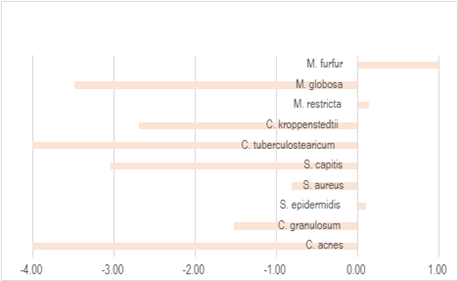
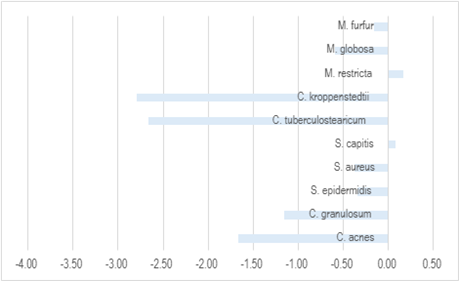
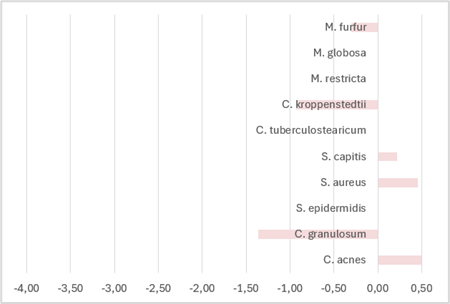
Figure 2. Impact of 3 moisturizers measured (Score impact in Log10 variation compared to a non-treated control)
The results reveal a high heterogeneity in the activity of formulations on microorganisms. We have identified antimicrobial effects that alter microbiome diversity, as well as a loss of biofilm-forming capacity, which could compromise microbiome preservation while others exhibit an overall neutral effect, with no significant impact on these parameters.
Just as toxicity testing on eukaryotic cell lines is required, safety testing on the commensal microbiota, considered to be a second skin, will eventually be necessary to ensure product safety.
4. Measuring the Impact of Cosmetics, a Key Component of the Exposome, on Skin and Scalp Microbiomes
At BYOME LABS, we specialize in measuring the impact of cosmetic products on the skin and scalp microbiomes using in vitro testing approaches. These methods generate robust and reproducible data to support validated claims. By assessing how formulations influence microbial growth, diversity and balance, we provide reliable evidence of their effects on the microbiome under controlled conditions.
Our expertise is built around key microbial strains representative of the skin and scalp ecosystems. This enables us to evaluate both the microbiome compatibility of products, ensuring they preserve microbial balance, and their efficacy in targeted contexts of dysbiosis such as atopic dermatitis or dandruff. Through this dual approach, we demonstrate whether a product is not only safe for the microbiome but also capable of restoring or supporting its equilibrium.
Reconstructed human epidermis models are widely used to study skin microbiome interactions under controlled conditions. Developed from primary keratinocytes, they form a functional epidermal barrier that closely mimics native skin (Boxberger et al., 2021). At BYOME LABS, these models are combined with microbial colonization to evaluate the impact of cosmetic products on the skin microbiome in physiologically relevant conditions, enabling robust and reproducible measurements.
Contact:
info@byomelabs.com
Website: www.byomelabs.com

Sources:
Boxberger, M., Cenizo, V., Cassir, N., & La Scola, B. (2021). Challenges in exploring and manipulating the human skin microbiome. Microbiome, 9(1), 125. https://doi.org/10.1186/s40168-021-01062-5
Gilaberte, Y., Piquero-Casals, J., Schalka, S., Leone, G., Brown, A., Trullàs, C., Jourdan, E., Lim, H. W., Krutmann, J., & Passeron, T. (2025). Exploring the impact of solar radiation on skin microbiome to develop improved photoprotection strategies. Photochemistry and Photobiology, 101(1), 38‑52. https://doi.org/10.1111/php.13962
Grant, G. J., Kohli, I., & Mohammad, T. F. (2024). A narrative review of the impact of ultraviolet radiation and sunscreen on the skin microbiome. Photodermatology, Photoimmunology & Photomedicine, 40(1), e12943. https://doi.org/10.1111/phpp.12943
Grice, E. A., & Segre, J. A. (2011). The skin microbiome. Nature reviews. Microbiology, 9(4), 244‑253. https://doi.org/10.1038/nrmicro2537
Paul, J. K., Azmal, M., Talukder, O. F., Haque, A. S. N. B., Meem, M., & Ghosh, A. (2025). Unlocking the secrets of the hair microbiome : From scalp health to therapeutic advances. The Microbe, 7, 100353. https://doi.org/10.1016/j.microb.2025.100353
Santos, Y. R., Andréo-Filho, N., Lopes, P. S., & Leite-Silva, V. R. (2026). A review of skin microbiome and new challenges to cosmetic microbiome-friendly formulations. International Journal of Cosmetic Science, n/a(n/a). https://doi.org/10.1111/ics.70073
Townsend, N., Hazan, A., & Dell’Acqua, G. (2023). New Topicals to Support a Healthy Scalp While Preserving the Microbiome : A Report of Clinical and in Vitro Studies. The Journal of Clinical and Aesthetic Dermatology, 16(10 Suppl 1), S4‑S11.
To know more about Byome Labs expertise: https://www.skinobs.com/p/labo.php?id=324