
Paris, April 2026
What does it take for a cosmetic trend to become a durable innovation vector? That was, in essence, the central question running through this year’s edition of In-Cosmetics Global. Over three days of presentations, the Testing & Lab Zone, and countless booth conversations, a coherent set of signals emerged, confirming some established trajectories while sharpening the analytical tools with which the industry intends to substantiate them.
A Market Under Pressure, Yet Structurally Solid
The contextual backdrop, as framed by Euromonitor International, is one of cautious confidence. The European beauty market reached €104 billion in retail sales in 2024, with skincare remaining the dominant category at €30.1 billion and export value hitting €29.4 billion. These are not the figures for an industry in contraction.
Yet the pressure points are real. Three regulatory changes alone are reshaping formulation and testing pipelines: France’s January 2026 prohibition on PFAS in cosmetics, the extended EU fragrance allergen list coming into force on 31 July 2026 (covering over 80 additional allergens), and the new formaldehyde labelling obligation, any finished product exceeding 0.001% total concentration must now carry an explicit warning. For testing laboratories and R&D teams, these evolutions are not abstractions. They translate directly into revised safety dossiers, additional analytical workloads, and tighter claim substantiation requirements.
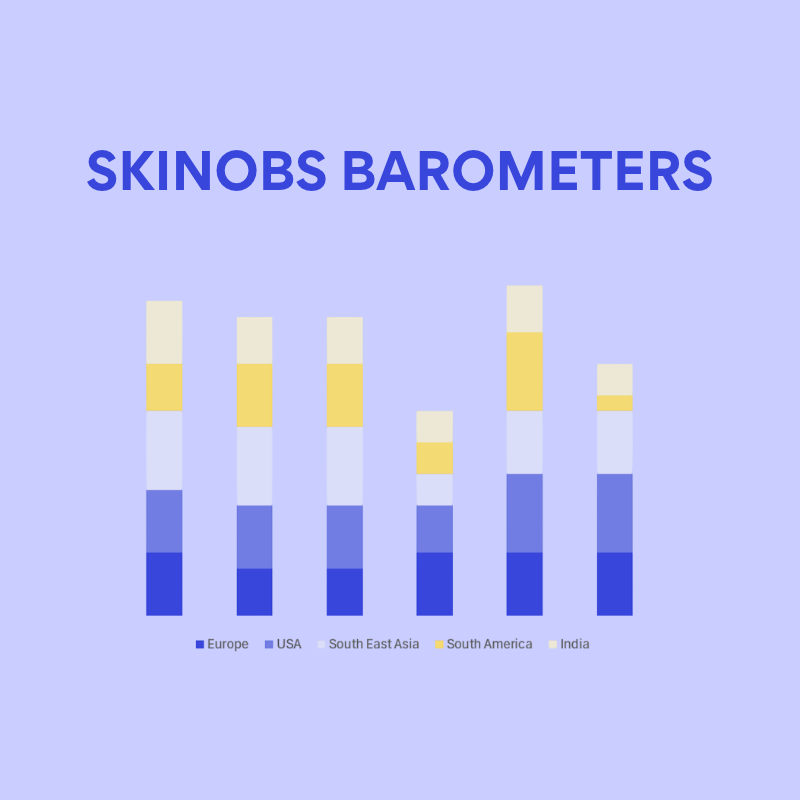
Against this background, the Skinobs platform, which aggregates over 270 clinical testing providers and 200 preclinical assay suppliers worldwide, covering more than 500 methodological approaches and 190 claim categories, offered a panoramic view of the testing trends shaping the market. Its Boost Your Test webinar series, running a week after the show, mapped three structural testing priorities that aligned closely with what could be observed walking the Testing & Lab Zone floor.
Longevity: From Marketing Concept to Biological Framework
The most structurally significant theme of the show was longevity, not as a product category, but as a scientific paradigm shift. Euromonitor International framed it clearly: the industry is moving from anti-aging (surface correction, covering signs) to longevity (biological health and resilience of skin and hair over time). The distinction matters because it changes what you test, what you claim, and what you need to prove.
Three biological mechanisms underpin this transition: oxidative stress, cellular senescence, and inflammaging. Each demands its own evaluation toolkit. Cellular senescence, the accumulation of so-called “zombie cells” that impair tissue repair, is perhaps the most intellectually challenging for conventional cosmetic testing frameworks. It requires markers and endpoints that go well beyond traditional TEWL measurements or colorimetry. The show floor reflected this: several preclinical testing providers and ingredient suppliers were explicitly positioning their offerings around these mechanisms, with ex vivo models, 3D reconstructed skin systems, and increasingly, organoid-based approaches.
This last point was illustrated with exceptional scientific rigour in one of the show’s most technically ambitious presentations. The research, from a Korean cosmetics R&D centre, described the development of a human hair organoid model derived from embryonic stem cells, capable of generating pigmented hair shafts after over 100 days of in vitro culture. The model was then exposed to stress hormones, norepinephrine and cortisol, to reproduce stress-induced hair greying, a phenomenon well-documented in animal models but until now difficult to translate credibly into human biology.
The results were striking : stress hormone treatment produced measurable melanin reduction in isolated hair shafts, confirmed by ImageJ analysis of hair blackness intensity. Single-cell RNA sequencing revealed stress-induced transcriptional trajectory shifts, disrupted IGF and CADM signalling pathways between melanocytes and surrounding niche cells, and evidence of melanocyte stem cell quiescence and melanosome mislocalisation. The organoid system was then used to screen active ingredients, including black ginger extract and a soybean-derived compound, for their ability to maintain hair pigmentation under stress conditions, with visible results at the hair shaft level.
For testing professionals, this work is important for two reasons. First, it demonstrates a credible pathway to bridging in vitro, ex vivo, and clinical evidence for hair longevity claims, a space where the evidentiary chain has historically been fragile. Second, it shows that organoid platforms, long discussed as a theoretical replacement for animal testing, are now generating publication-quality data with direct formulation relevance. The question for CROs and brand R&D teams is no longer whether these models will arrive, but how quickly they will be standardised and industrialised.
Euromonitor International’s scalability data provides one measure of how the broader market is moving: among the longevity-associated ingredients tracked across beauty launches, ceramides, niacinamide, hyaluronic acid, pro-vitamin B (panthenol), and peptides lead in SKU count — with ceramides showing particularly strong growth rates across both mass and masstige segments. These are ingredients for which the evaluation methodology is mature. The challenge moves upstream, toward senomorphics, NAD+ precursors, epigenetic modulators, and the novel actives that will define the next wave.
Wellbeing, Neurocosmetics and the Beauty Sleep Paradigm
The second major testing trend confirmed at the show was wellbeing, a sprawling category that now includes, in formulation terms, anti-dark circles, anti-puffiness, stress reduction, mood enhancement, CBD-adjacent claims, and sleep-supportive benefits. Data from the in-cosmetics Global ingredient census listed 138 ingredients dedicated to mood-enhancing and stress-reducing functions at the 2025 edition, alongside 64 ingredients targeting the gut-skin axis.
What is shifting is the evidentiary demand. “Beauty sleep” has moved from a consumer metaphor to a scientifically defined concept: the 7-9 hour sleep window in which the body repairs tissues, boosts collagen synthesis, and reduces cortisol. Cosmetic products positioning around sleep quality or circadian rhythm support, whether through melatonin-related pathways, cortisol modulation, or topical actives promoting regenerative states — now require a different kind of substantiation. The Skinobs analysis flagged cognitive and behavioural testing as an emerging methodological area, alongside consumer interest monitoring around specific biomarkers like cortisol and melatonin.
This intersects directly with neurocosmetics, a field that has been “talked about by everyone” for several years but is now beginning to acquire testable endpoints and measurable outcomes. The presence of neurocosmetic-focused evaluation providers in the Testing & Lab Zone was a signal that the instruments and protocols for capturing neurological or emotional response to cosmetic application are maturing. For claim substantiation teams, this raises a practical question: what does a robust neurocosmetic claim actually look like, and what study design supports it? Answers are still emerging, but the methodological infrastructure is being built in real time.
Microbiome: Depth Over Breadth
The microbiome remains a central claim area, and the Skinobs platform data confirmed its structural presence in the testing landscape. What has changed since the first wave of microbiome-inspired launches is the level of sophistication expected, both from the science and from regulators. Generic “microbiome-friendly” claims, once sufficient, now invite scrutiny. The presence of multiple dedicated microbiome testing providers in the Testing & Lab Zone reflects a market that has specialised: sequencing approaches, diversity indices, specific strain analysis, and ex vivo skin explant models are now standard tools rather than differentiators.
The new skin barrier narrative — moving from “skinimalism” to stress-adaptive protection, connects the microbiome to the wider longevity framework. Barrier integrity is no longer assessed solely through classical biophysical parameters (TEWL, capacitance, pH) but increasingly through its functional relationship with microbial communities and its resilience under chronic stress conditions. For testing providers, this means multi-endpoint study designs are becoming the norm rather than the exception.
An Instructive Brand Model: Science as a Competitive Architecture
One of the show’s presentations offered something relatively rare at an industry event: a detailed, honest account of how a major independent beauty brand operationalises its science claims, from ingredient investigation through to marketing finalisation. The brand in question, parent company to a widely known evidence-based skincare range, runs a 20,000 sq ft R&D hub with five dedicated labs and a 110,000 sq ft ISO-certified manufacturing facility. Its applied research function is organised around three pillars, preclinical discovery, delivery sciences, and clinical operations, each contributing to a five-stage claims development pipeline: investigation of formulation actives, proof of concept in-house, claims direction, substantiation (safety + efficacy), and marketing finalisation.
What stood out was the deliberate integration of delivery sciences as a first-class research function. A microemulsion case study illustrated how microfluidisation technology, drawn from pharmaceutical and biotech applications and operating at pressures up to 30,000 psi, was applied to reduce particle size, improve barrier penetration, and generate quantitative hydration mapping data via Raman spectroscopy. Aquaporin-3 expression was measured against untreated controls. The resulting claim was built on both molecular and biophysical evidence, with each layer of the evidentiary chain explicitly mapped to the claim language.
For testing labs working with brands on this type of programme, this model underlines a trend visible across the show: brands are building their own internal evaluation infrastructure, using supplier data ecosystems, biological, safety-toxicological, clinical, as inputs rather than primary outputs. The implication for CROs is a shift from study execution to scientific partnership. Labs that can engage at the mechanism-of-action and study design level will be better positioned than those offering commodity testing alone. The internal scoring approach described — rating ingredients on a 10-point scale combining in vitro, ex vivo, and in vivo evidence against standardised rubrics is the kind of quality gate that raises the floor for what external providers must deliver.
The Human Revival: What Consumer Psychology Means for Evaluation
The most provocative argument at the show came not from an ingredient supplier or testing provider, but from a market intelligence firm. The thesis, supported by recent Mintel consumer surveys: the beauty industry faces a “human revival” moment, driven not by ingredient science but by consumer psychology in response to the proliferation of AI-generated content and automated curation.
The data points are worth noting for their claim implications. Some 80% of US adults familiar with AI say it makes them value things created by humans more (Mintel, April 2025). Some 62% of French beauty consumers want explicit disclosure when AI has been used in product development (Mintel, September 2024). And 58% of German adults agree that AI advancements are making it hard to trust online content (Mintel, May 2025). A related finding showed that nearly half of Gen Z consumers in Germany consider it important that a brand openly admits mistakes in order to appear authentic.
Three behavioural principles were proposed as levers brands can consciously engage: the Pratfall Effect (admitting limitations increases trust), the IKEA Effect (participation drives perceived value), and the Effort Heuristic (perceived production effort signals quality). The strategic conclusion: transparency and provenance have become foundations of brand trust, and loyalty is increasingly built through high-touch communities and visible craftsmanship rather than opaque efficacy claims.
For the testing and evaluation community, the implications are less abstract than they might appear. Consumer claims, sensory panels, self-assessment questionnaires, wearability studies, are not disappearing; they are being reframed. The “human signal” that drives purchase is increasingly what substantiates a claim in consumer communication. This means that study designs capturing authentic experience, including honest disclosure of methodological limitations, may carry more commercial weight than technically flawless but opaque instrumental studies. The question of how to communicate science with honesty, not just accuracy, is becoming a claim strategy question as much as a scientific one.
Synthesis: What Testing Professionals Should Be Watching
Across all presentations and the broader show experience, several convergent signals deserve attention from R&D and evaluation professionals:
Organoid and advanced in vitro models are moving from research curiosity to formulation tool. The award-winning hair organoid work presented at the show is not an outlier, it is a direction signal for the entire field of hair and scalp evaluation.
Multi-mechanism, multi-endpoint study designs are becoming necessary to substantiate longevity claims credibly. Single-parameter studies will increasingly struggle under both regulatory and market scrutiny.
Cognitive, behavioural, and neurological evaluation methods are acquiring scientific legitimacy. Testing providers with expertise in these areas are well positioned for the next five years.
Regulatory pressure is accelerating , PFAS, allergens, formaldehyde: the 2026-2027 compliance pipeline will generate significant demand for analytical and safety testing services across Europe.
Transparency is not just an ethical position; it is a claim strategy. As consumer expectations around AI disclosure, ingredient provenance, and brand honesty continue to rise, the way science is communicated becomes as strategically important as the science itself.
In-Cosmetics Global 2026 confirmed that the industry’s most durable direction of travel is toward deeper biological understanding, more rigorous substantiation, and a re-humanisation of the relationship between brands and their consumers. For those building the evidence behind the claims, the opportunity and the responsibility has rarely been more clearly defined.
Sources: Euromonitor International (market data and longevity framework, March 2026); Mintel (consumer insights, 2024–2025); Skinobs / Boost Your Test webinar (testing trends and platform data, April 2026); In-Cosmetics Global 2026 presentations. Market figures: Cosmetics Europe.