In vitro skin models have become indispensable tools in cosmetic and dermatological research. They enable mechanistic investigations, early efficacy screening, and claims substantiation while reducing reliance on animal testing. However, when it comes to oily and acne-prone skin, traditional 3D systems present a major physiological limitation: they lack sebaceous glands and therefore cannot produce sebum.
Recognizing this gap, QIMA Life Sciences has developed customizable in vitro models integrating synthetic sebum profiles and, when required, controlled bacterial communities. With this innovation, QIMA Life Sciences aims to provide researchers and brands with more predictive, physiologically relevant tools for acne and oily skin research.
Addressing the Sebum Gap in Traditional Models
Standard 3D reconstructed human epidermis (RHE) models are widely used and scientifically validated. Yet, they do not contain sebaceous glands. As a result, they fail to reproduce the lipid-rich surface environment that characterizes oily and acne-prone skin.
To overcome these limitations, QIMA Life Sciences designed a model introducing sebum conditions into 3D systems. The objective was clear: improve the predictive value of preclinical studies by better mimicking real-life oily skin environments.
Reproducing the Hormonal and Dynamic Nature of Sebum
Sebum production is tightly regulated by hormonal signaling, particularly androgens such as testosterone and dihydrotestosterone. These hormones act directly on sebocytes, influencing both the quantity and composition of lipids produced.
QIMA Life Sciences took this physiological complexity into account when developing its models. Sebum is not a static entity; its profile varies across individuals and life stages. Puberty, menstrual cycle phases, pregnancy, menopause, stress, insulin/IGF-1 signaling, and hormonal treatments can all modulate sebaceous activity.
Through carefully formulated synthetic sebum blends, QIMA Life Sciences enables researchers to replicate balanced or altered lipid states. Lipid ratios and total lipid load can be adjusted to simulate teenage skin, adult oily skin, or hyperseborrheic conditions. This controlled customization allows brands to test active ingredients under clearly defined, physiologically meaningful scenarios.
Integrating the Microbiome Dimension
Beyond lipids, QIMA Life Sciences recognized that acne-prone skin is shaped by the interplay between sebum and the microbiome.
Lipid availability strongly influences bacterial proliferation and behavior. Conversely, bacteria can metabolize sebum components, modifying lipid composition and generating inflammatory mediators.
To capture this bidirectional interaction, QIMA Life Sciences developed advanced versions of its 3D models that combine sebum-enriched reconstructed epidermis with controlled inoculation of skin-relevant bacterial strains. These include Cutibacterium acnes, Staphylococcus epidermidis, Staphylococcus aureus, and Corynebacterium xerosis.
By integrating both defined lipid environments and precisely quantified bacterial loads (CFU-controlled), QIMA Life Sciences enables detailed studies of microbial competition, dysbiosis, and modulation by topical formulations. This dual sebum-plus-bacteria configuration offers a more realistic representation of acne-prone skin within a fully controlled laboratory setting.
A Modular Portfolio of 2D and 3D Systems
QIMA Life Sciences offer models as a modular platform to address diverse research needs.
2D Sebocyte Models
Human sebocyte monolayers for high-throughput evaluation of lipid synthesis, lipid accumulation, and inflammatory responses. For hormone-focused studies, androgen-sensitive sebocyte lines expressing functional androgen receptors allow precise modeling of androgen-driven pathways.
These 2D systems are particularly suited for early-stage screening of sebum-regulating or anti-inflammatory active ingredients.
3D Reconstructed Epidermis Models
3D RHE models supplemented with standardized artificial sebum applied to the surface. This recreates an oily-skin microenvironment and allows evaluation of barrier integrity, lipid interactions, and formulation performance.
For more advanced investigations, QIMA Life Sciences further enhances these models by inoculating them with defined bacterial communities under controlled conditions. This enables comprehensive assessment of how formulations influence both lipid balance and microbial ecosystems.
Generating Mechanistic Insights
Early internal studies conducted by QIMA Life Sciences using these integrated models have already generated meaningful insights.
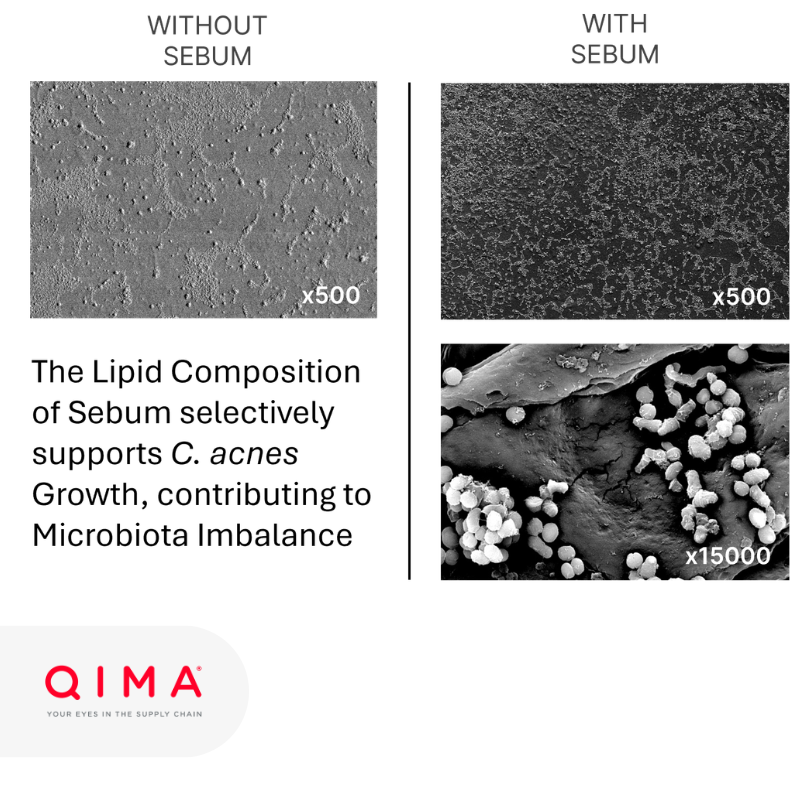
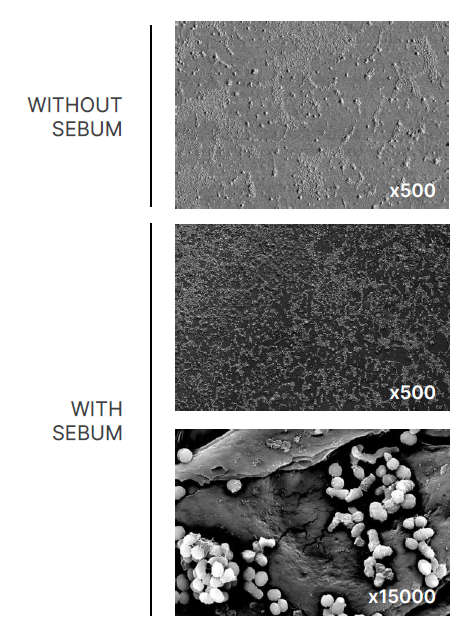
One key observation is that the presence of sebum significantly enhances the proliferation of C. acnes, confirming its adaptation to lipid-rich environments. Moreover, C. acnes was shown to alter the lipid environment itself, reducing total lipid content—particularly triglycerides—and shifting the overall lipid profile.
When mixed microbial communities were introduced, QIMA Life Sciences observed that specific sebum compositions selectively favored C. acnes over other species. These findings illustrate how lipid environments can shape microbial dominance and potentially drive dysbiosis.
Such mechanistic data provide valuable guidance for formulation strategies.
Customization as a Strategic Advantage
A defining strength of this platform lies in its flexibility. QIMA Life Sciences does not offer a single generic “oily-skin” model. Instead, each project can be tailored according to scientific objectives.
Researchers working with QIMA Life Sciences can:
- Define precise lipid compositions and concentrations
- Adjust total sebum load to mimic specific physiological states
- Select individual bacterial strains and control inoculation levels
- Combine lipid and microbiome parameters to replicate targeted scenarios
This high level of customization ensures reproducibility while maintaining strong biological relevance.
From Early Screening to Claims Substantiation
For brands and R&D teams, QIMA Life Sciences provides a practical bridge between simplified in vitro assays and the complexity of human skin.
These models support:
- Screening of anti-acne and sebum-regulating actives
- Benchmarking against competitor products
- Investigation of microbiome-related claims
- Testing formulations under clearly defined oily-skin conditions
By delivering robust, physiologically relevant data early in the development process, QIMA Life Sciences helps reduce downstream risk before clinical evaluation. These innovative systems represent a significant step forward for acne research and dermocosmetic innovation.
CONTACT
Alain Moga – Head of Cosmetics