

HEV Light: Benefits, risks, and the requirements to establish a reliable dose
Blue light, or more appropriately High Energy Visible (HEV) light, has multiple and often underestimated effects on skin. HEV light ranges from approximately 400 nm to 500 nm, and actually covers frequencies that include violet, blue and cyan spectra. It is less penetrative that any other visible frequency, although it still reaches deeper in the skin than UV light, and also carries the highest energy levels among visible light frequencies.
Please note that these separations, are arbitrary and based on the human eye perception of colors. In reality, these effects of light on the skin and tissues usually have a Gaussian distribution.
The main source of HEV light is obviously sunlight, with the exposure levels being approximately 50 J/cm2 per hour in midsummer. Twenty to fifty J/cm2/h is also the minimum dose reported to induce significant mitochondrial DNA damage, as described below. As nonmedical, artificial sources of HEV-L are 1/10 of this or less, their effects are not relevant.
Skin damaging effects
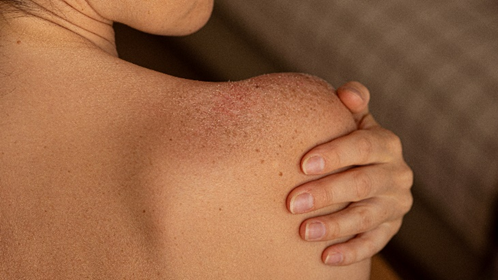
As a primary negative effect, these frequencies induce both intracellular and extracellular ROS generation, leading to DNA damage in the nucleus and, mainly, in mitochondria. In the latter, this DNA damage is responsible for the impairment of specific genes involved in the synthesis and release of electron-transport proteins involved in cellular respiration. This then reduces the production of ATP, the main source of energy for cellular processes.
A close-second negative effect is the inhibition of fibroblast and keratinocyte mitosis, either by delaying metaphase or by exiting the cycle into interphase without chromosome separation. This effect is more pronounced at lower wavelengths, between 400 and 425 nm. Other sources of direct skin damage include apoptosis induction, increasing several types of pro-inflammatory cytokines, and producing hyperpigmentation in melanocytes resulting in potential pathologies such as melasma.
Furthermore, ROS and nitric oxide generation promote a slew of secondary effects. They increase the synthesis of several interleukins (IL-1α, IL-6, IL-8) and the presence of proinflammatory macrophages. They severely damage filaggrin, elastin and especially collagen, thus compromising the structure of the stratum corneum. Collagen is more affected, as it is also damaged by other HEV-induced factors such as the production of metalloproteases and direct exposure. Additionally, ROS overproduction has been linked to increased level of cortisol, a stress related hormone, with cascading effects in the skin.
Positive effects
Despite the effect of blue light on the synthesis of cytokines, its effects at mid intensity and above the 450 nm threshold can actually reduce inflammation. Exposure to HEV frequencies within these requirements was proven effective in reducing IL-1α levels and attenuate inflammatory conditions such as acne, atopic dermatitis and psoriasis. HEV frequencies were also proved effective in reducing the secretion of all pro-inflammatory cytokines, with the exception of IL-4, by dendritic cells.
HEV light was also effective in reducing microbial and fungal skin infections, and has anticarcinogenic activity on skin and other tissues. On the skin, HEV light being applied skin cancers such as melanoma or squamous-cell carcinoma is easy and feasible. Affecting oral, vaginal or rectal cancers has also been proved, but would be more difficult and intrusive.
Testing for HEV light protection
There is no standardized method for testing protection against HEV light, and indeed a direct test would be less useful in this case, as the main effects of HEV frequencies that an individual would wish to protect from are mid to long term.
Since the main effects of HEV light are caused by creating ROS and metalloproteases, their indirect effect on cells is more relevant. Keratinocytes or fibroblasts can be exposed to HEV frequencies through plates treated with glycerol (which displays an HEV absorbance nearing 0 – PC) or the product acting as a protective. Unexposed cells kept at the same temperature and humidity could be used as a NC. Direct comparison of the three groups would result in a quantifiable reduction, on a scale of 0 to 100 (NC and PC).
Since a main effect of HEV light is the inhibition of cell mitosis, irradiating cells in such a pattern would detect this. Repeated exposures under HEV light and rest periods could be used to quantify the progression and compound effects.
Establishing a dose that would reliably damage the cells is the most relevant issue in this case. A round-robin of testing between several laboratories would be required to establish a dose that would reliably lead to a 70%-80% cell viability decrease. The thickness of the product to be tested would also become a factor. Applying the product with the same requirements of an ISO standard (i.e. ISO 24443) would solve this issue until a standardized test is published.
Test with us to enhance the quality of your products!
HEV light has great potential, but only with the right dose can we ensure real benefits and minimize risks. With our support, you can assess the effectiveness of protection, optimize exposure conditions, and rely on validated in vitro testing protocols to identify the conditions under which exposure poses greater risks. Contact us to learn more about our dedicated HEV light services, tailored to your product!
Contact
Emiliano Ripamonti – R&D Specialist
Contact: info.abich@lifeanalytics.it
Website: https://www.lifeanalytics.it/lifeanalytics-unit/cosmetic-medical-device

To know more about Abich expertise: https://www.skinobs.com/c/labo.php?id=56&lang=en


