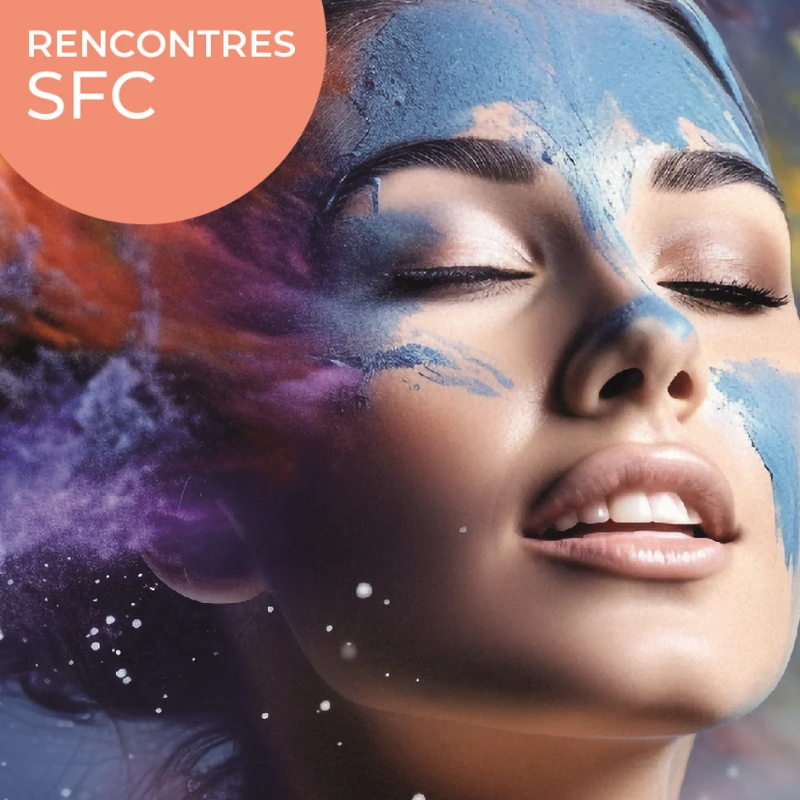
Held in Paris on 4 June, the SFC Rencontres “Maquill’ÂgeS” brought together historians, brands, ingredient suppliers, regulatory experts and evaluation specialists around four themes: history and trends, formulation, regulation, and testing. The title unites colour and anti‑ageing, speaks to every generation, and invites the industry to move beyond overclaiming and prescriptive norms towards a more inclusive vision of beauty.
From Egyptian kohl to neuroscience
Historian Laure Nicaise opened the day with Egyptian kohl containers recovered among funerary offerings. Green and black eye paints combined aesthetic, antibacterial and ritual functions: kohl symbolically restored the Eye of Horus. Papyri and iconography trace the evolution of the eyeliner stroke over time. Hélène de Clermont‑Gallerande (Chanel) demonstrated that facial contrast diminishes with age across all ethnicities, with a duller complexion, more pronounced dark circles and pigmentary spots. Restoring this contrast, with a focus on the lips and eyes, rejuvenates the face, enhances perceived femininity and strengthens self‑confidence. For Philippe Msika (Makilab Innovation), make‑up is both an intimate gesture and a social and emotional signal. The brain forms a first impression within 250 milliseconds: the interface between make‑up and skin thus becomes neuropsychological, with measurable effects on stress and self‑esteem.
Trends, colour and formulation: skincare enters make‑up
Mara Imberti (Skinlys) outlined three trends: multifunctionality and skinification, haptic make‑up with touch‑activated textures, and comforting nostalgia. On the product side, “super natural” complexions, multilayer glossy lips, eye‑centric looks and built‑in sun protection prevail. Aurélie Banco (Grolman) examined the future beyond carmine, talc, mica and titanium dioxide. Élodie Carpentier (Le Rouge Français) presented colours derived from dye plants, in a market where 99% of make‑up colour remains petrochemical. Sandrine Zeppa (Susonity) unveiled the Color Forecast RE/GENERATION 2028. The formulation session confirmed two requirements: sensoriality and naturalness, with no compromise on performance. Yves Rocher combined sensory, emotional and instrumental analyses of lipsticks; Anjac presented a hot‑process solid emulsion for mature skin; and Gattefossé a hybrid foundation serum bridging skincare and make‑up.
Substitute and substantiate: new materials, new requirements
Raw material substitution is gaining ground: Imerys offers a European mica extracted from granite, Sensient a gardenia blue converted into a stable natural pigment, and Evonik natural polyglyceryl emulsifiers as an alternative to silicone‑based systems. Luisa Oliva (LO) emphasised that the interplay between light and formula shapes consumer emotion. On the regulatory front, Camille Bassier (Inside Cosmetics) highlighted ingredients under scrutiny: silica, talc, titanium dioxide and pearlescent pigments. She advocated pre‑assessment of formulas, careful screening of claims and rigorous presentation of results, including comparable before‑and‑after visuals. Particular vigilance is required regarding influencer communication, environmental claims governed by the French AGEC anti‑waste law, and the safety of formulas intended for young consumers.
Evaluating make‑up to skincare standards
The testing session made it clear: make‑up evaluation now meets the standards of skincare. L’Oréal (Jérôme Bonnard) assesses the cohesion and adhesion of deposits in vitro through tensile, friction and peel tests. The FLAME robot, the “kiss” transfer test and a study of the impact of shade on wear complete the approach, underpinned by a data repository leveraged by AI for predictive purposes. Dow (Ingrid Vervier) reconciles shine and long wear through an in vitro method on rough VitroSkin substrate, combining SAMBA and glossmeter measurements. Stéarinerie Dubois (Fabien Merlaud) demonstrated how the structure of sensory‑functional esters governs pigment dispersion, spreadability, gloss and colorimetry. Microfactory (Fabrice Monti) reviewed in vitro and in vivo models and underlined the value of dynamic synthetic skins for generating large, reproducible datasets. In the absence of a shared coverage threshold, SP Equation (Erika Davin Mariotti) proposed a robotised spectrocolorimetric method. Finally, Skinobs and Cos&Co (Anne Charpentier and Pascale Barlier) asked: “Wear, colour, radiance, what else?” Their overview of current trends and evaluation technologies makes the case for hybrid, skincare‑inspired protocols capable of characterising products that have become multifunctional.
Four key signals
- Skincare benefits have become inseparable from make‑up.
- Sensory experience lies at the heart of perceived performance.
- Texture sensoriality and formula naturalness are two confirmed requirements.
- Objectivation methods now make it possible to substantiate genuine efficacy.
Creativity, sustainability, raw material substitution, inclusivity, AI and data science, safety and compliance: these are the keywords that will drive tomorrow’s innovation. As Wassily Kandinsky wrote, “Colour is a power which directly influences the soul.”