
Skin cosmetic products and treatments: an advanced technology developed by Novitom for revealing structure and interactions at the molecular level in the stratum corneum
Why looking at intercellular lipids in stratum corneum?
The barrier function of the stratum corneum (SC) is closely linked to the organization of its intercellular lipids, hence the importance of characterizing and monitoring it to highlight and control the effect of cosmetic treatments.
The mixture of physiological lipids (ceramides, fatty acids, cholesterol) is organized into complex lamellar stacks arranged parallel to the plane of the corneocytes. In the lipid layers, domains with a crystalline organization coexist with amorphous domains.
Characterizing the molecular structure of the lipids in SC after treatment provides crucial information on the ability of a product to penetrate skin, to reinforce the skin barrier or to nourish the skin.
How characterize the lipid structure in SC?
The intercellular lipids of SC are usually characterized by DSC, Raman spectroscopy or TEM:
- DSC and Raman spectroscopy indicate whether lipids are in a crystallized or fluid state
- TEM is the only technique to clearly show the lipid stack between corneocytes. However, apart from the fact that observations are limited to very small areas, TEM does not provide any information regarding the lateral intra-layer organization of lipid chains.
To go beyond and reveal the molecular architecture of lipids, X-ray diffraction must be used.
The relevant parameters to describe the lipid structure in SC
X-ray diffraction provides information on:
- the lamellar stack of lipids (layer thickness, orientations)
- the lateral order of molecules inside the lipid layers (amorphous vs crystalline, lattice types, size of crystallized domains).
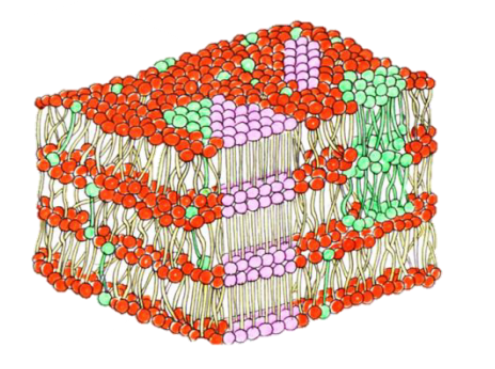
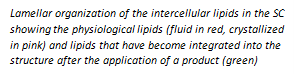
Since these parameters are remarkably similar from person to person, they can be considered as robust markers of the lipid barrier quality and can be used to monitor the changes induced by the application of a product or a treatment.
Novitom’s specialty: X-ray microdiffraction at the micrometer scale
To make the technique even more effective for cosmetic evaluation, Novitom has succeeded in developing measurement protocols using the remarkable power of Synchrotron X-rays source.
- Data is collected at a micrometric spatial resolution, thus opening the way to obtain all the structural descriptors according to the depth in the SC, from its external surface to the epidermal side.
- Data collection can be performed on pieces of isolated SC, removed from skin explant, either after ex vivo treatment or after topical application directly to the outer surface of the isolated SC. It is also possible to perform XRD measurements on tape strips, making this technique compatible with clinical studies.
Beyond the lipid structure, X-ray microdiffraction can also reveal the mechanism of action of a product
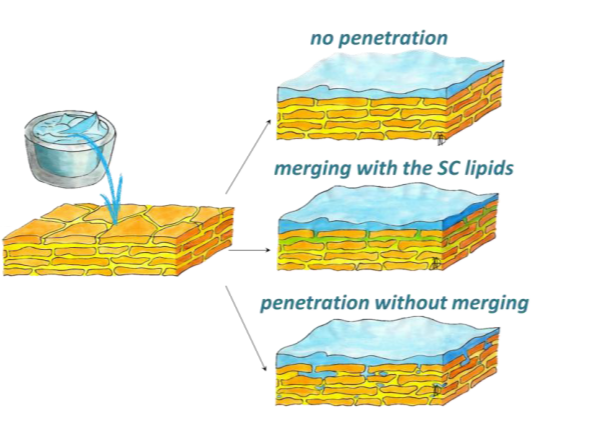
More precisely, the technique allows
- to identify the impact of a treatment on SC lipids by distinguishing treatments that do not induce modification of the physiological lipids structure from treatments that modify their lamellar organization, crystalline structures (hexagonal vs orthorhombic or other), or the amorphous/crystalline ratio (crystallinity)
- to discriminate if product molecules mix with the physiological lipids, or on contrary keeps segregated inside SC.
A valuable tool for both supporting R&D and developing marketing claims
Not only can X-ray diffraction technology provide robust support to formulators seeking to rationally improve their formulations, but it also allows their marketing colleagues to highlight claims such as nourishing, strengthening, or repairing aspects.
An example of behaviour of a mass-market cosmetic cream
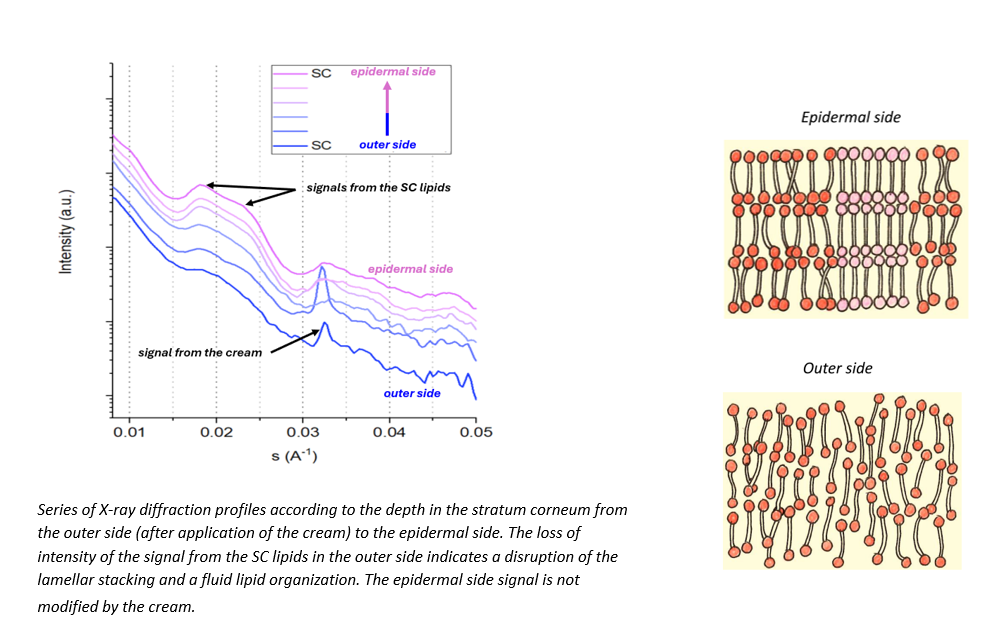
After applying this cream, the skin feels smoother and softer. What is the molecular origin of this sensation? Microdiffraction analysis provided an explanation. On the outer surface of the SC, where the cream was applied, the regular lamellar organization of intercellular lipids is significantly disrupted, while on the epidermal side, the lipids retain their physiological organization. This disruption on the outer surface most likely contributes to the feeling of softness, perhaps by facilitating desquamation.
Business contact
Emilie LECCIA
emilie.leccia@novitom.com