
At HPCI India, discussions with local players in cosmetic evaluation confirmed the importance of imaging tools capable of meeting the specific challenges of the Indian market, particularly in terms of skin pigmentation.
The Indian cosmetics market is experiencing a particularly strong dynamic, driven by very specific expectations in terms of facial care. Among the major concerns, skin pigmentation issues occupy a central place: uneven complexion, pigment spots, post-inflammatory hyperpigmentation or melasma are among the alterations most frequently targeted by dermocosmetic treatments.
These pigmentary disorders concern a wide variety of phototypes and require rigorous evaluation protocols, capable of detecting sometimes progressive and localized evolutions. In this context, the demonstration of effectiveness is based on the ability to objectify subtle changes, while guaranteeing perfect comparability over time.

The limits of conventional approaches to assessing pigmentation
Visual assessment is still widely used in clinical studies, but it has well-known limitations. The perception of pigmentation is highly dependent on lighting conditions, shooting angle, phototype, and evaluator’s experience. On pigmented skin, contrasts are often weak and variations are difficult to reliably appreciate.
Many tools on the market offer one-off or partial measurements, often limited to a small area or isolated color information. These approaches do not always capture intra-area variability, nor link numerical data to a global and usable visualization.
The contribution of calibrated imaging in pigmentation studies
Standardized imaging is a direct response to these limitations. By relying on a strictly controlled acquisition, it makes it possible to transform a visual observation into reproducible quantitative data, while maintaining an overall reading of the area studied.
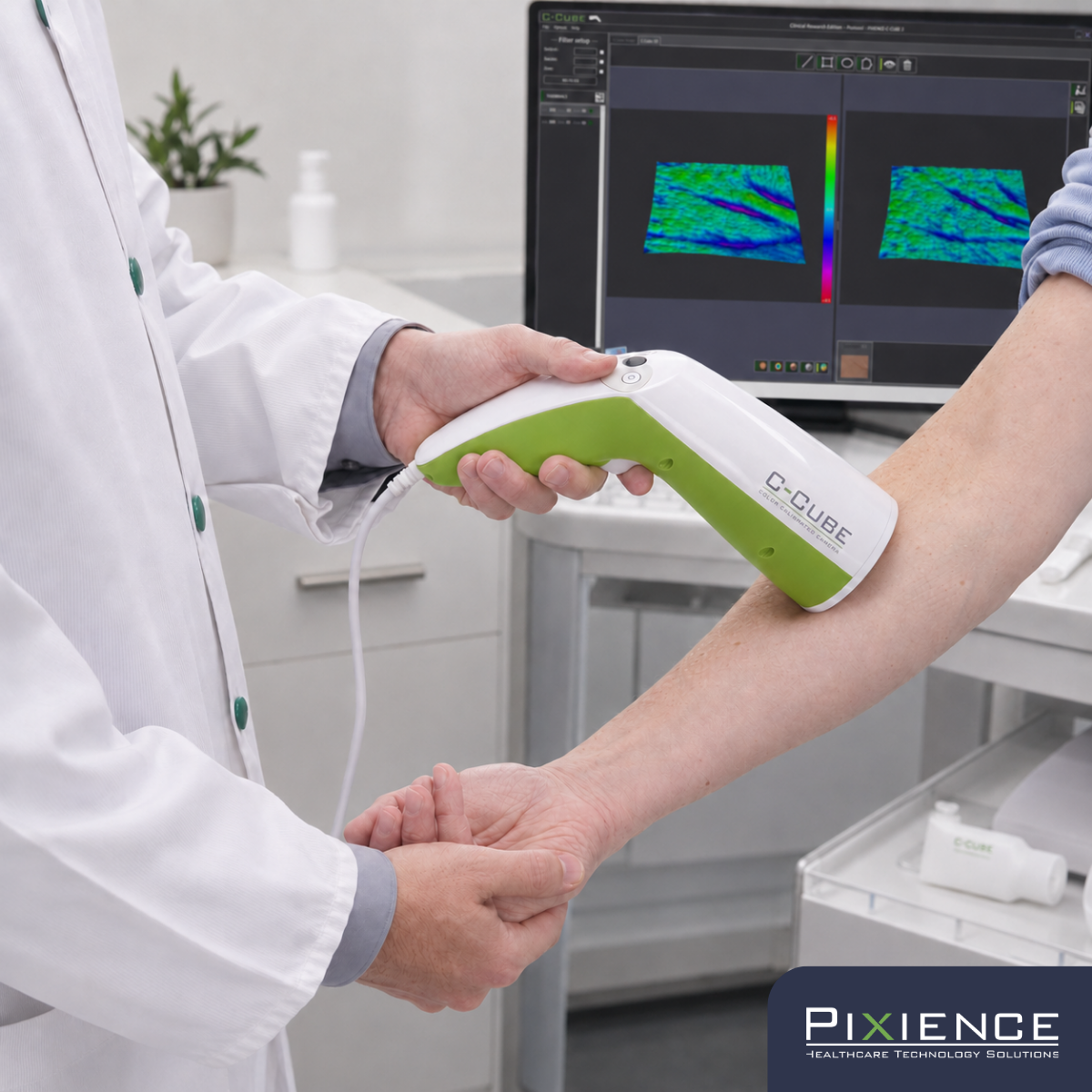
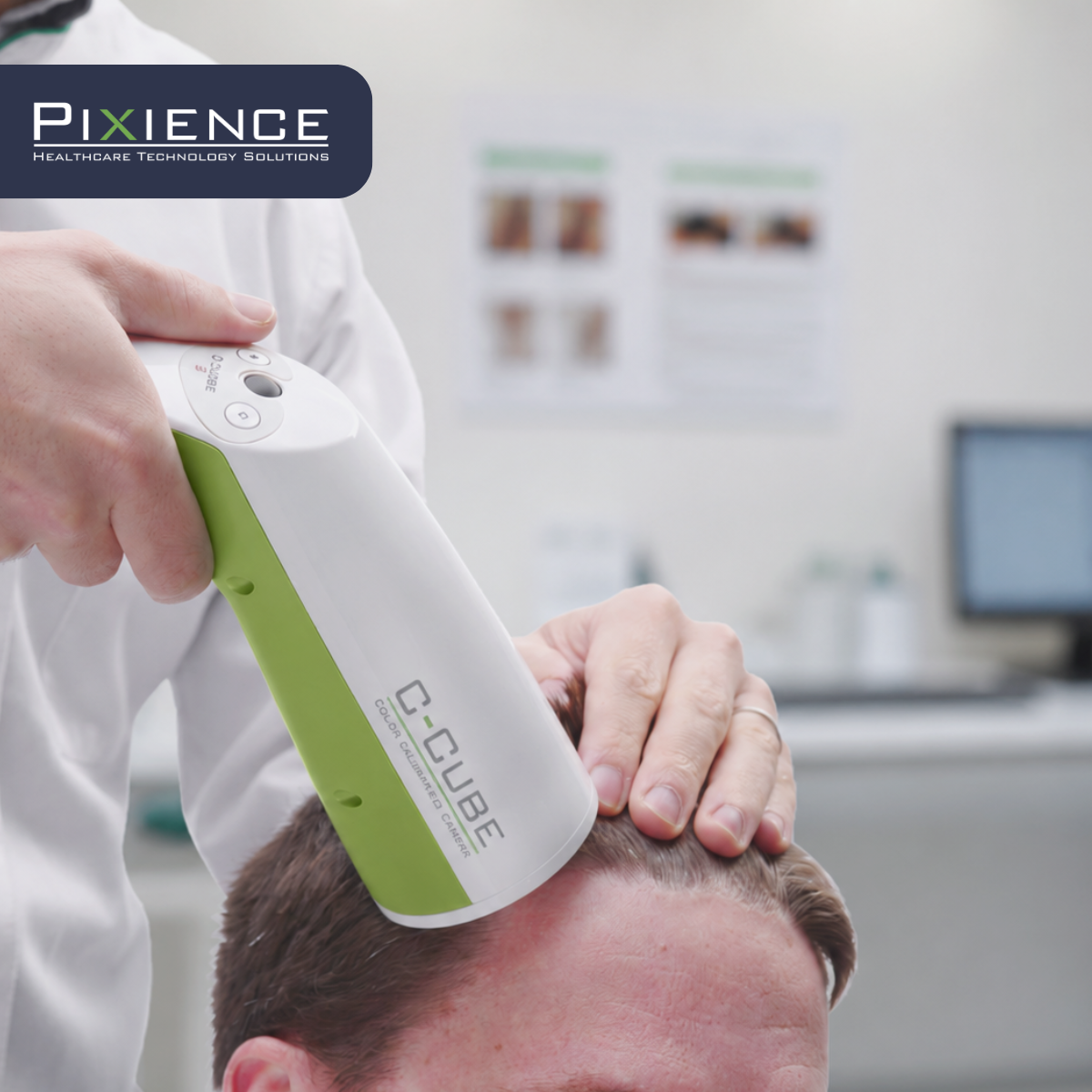
The C-Cube Clinical Research was designed with this in mind. Unlike conventional macro cameras or non-calibrated systems, it is based on:
- Lateral resolution: 0.008mm
- A colorimetric calibration,
- Metric calibration,
- Homogeneous and patented LED lighting, guaranteeing stability of capture conditions regardless of the operator or the environment.
Objectify skin pigmentation with the C-Cube
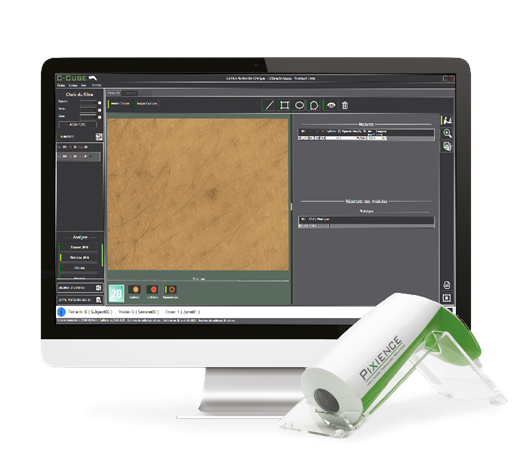
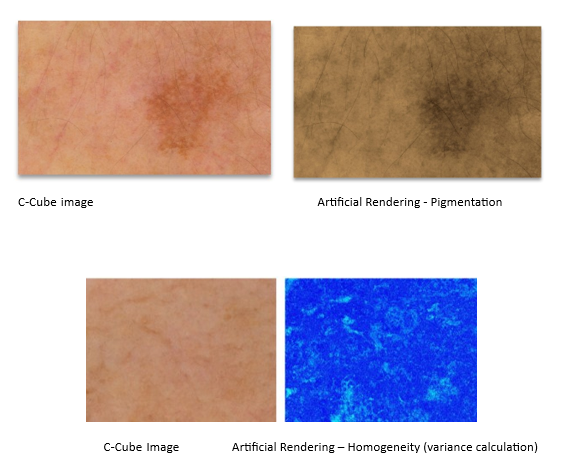
The C-Cube analyzes each pixel of the image from calibrated color data, allowing to calculate pigment indices over the entire area of interest.
Depending on the protocols, it is possible to extract:
- Overall pigmentation indexes,
- Localized measurements on targeted areas (spots, hyperpigmented areas),
- Maps to visualize pigment heterogeneity.
This approach is a key differentiator. It allows you to follow the evolution of a pigment spot with a minute precision, to evaluate the homogeneity of the complexion or to precisely compare treated versus untreated areas.
A differentiating tool
Where some devices are limited to point-in-time color measurements or poorly contextualized analyses, the C-Cube combines quantification, visualization, and reproducibility in a single system. This ability to provide both robust numerical data and actionable high-definition visuals is a major advantage, especially in markets where image plays a decisive role in the perception of efficiency.
In a highly digitalized environment such as India, this dual approach makes it possible to simultaneously meet scientific, regulatory and marketing requirements.
Towards a more demanding evaluation of lightening treatments
As pigmentation-targeted treatments become more sophisticated, assessment methods must evolve accordingly. Brands and CROs need tools that can support demanding claims, while ensuring transparency and credibility.
By combining calibrated imaging, automated analyses and visual restitution, the C-Cube Clinical Research is fully in line with this evolution, providing a concrete response to the current challenges of pigmentation-driven cosmetics.
Pixience would like to thank the organizers of HPCI India as well as all the experts met during the event for the quality of the exchanges around cosmetic evaluation methods.
CONTACT
Pixience
Sébastien Mangeruca
CEO
sales@pixience.com
https://www.pixience.com/c-cube-recherche-clinique/

Discover more about Pixience expertise here: https://www.skinobs.com/c/manufacturer.php?id=107